Tradition of St. Basil's Bread
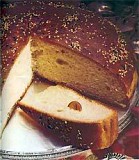
The tradition of Saint Basil’s Bread dates to the fourth century, when St. Basil the Great, the father of philanthropy, wanted to distribute money to the poor in his diocese. He commissioned some women to bake sweetened bread, in which he placed gold coins. Thus the poor families in cutting the bread to nourish themselves were pleasantly surprised to find the coins. This custom is kept to this day among Orthodox Christians, who on Saint Basil’s Day, January 1st, place gold coins inside a loaf of sweetened bread in honor of the Saint’s care for the poor. The one who finds the coin in his or her piece is considered commissioned by St. Basil to carry on his work for the poor, and in exchange he will ask the Lord for whatever is needful for the New Year.
Life of St. Basil the Great
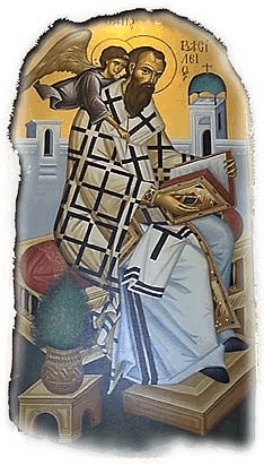
Basil was born during the reign of Emperor Constantine. While still unbaptized, Basil spent fifteen years in Athens where he studied philosophy, rhetoric, astronomy and all other secular sciences of that time. His colleagues at that time were Gregory the Theologian and Julian, later the apostate emperor. In his mature years he was baptized in the river Jordan along with Euvlios his former teacher. He was Bishop of Caesarea in Cappadocia for almost ten years and completed his earthly life fifty years after his birth. He was a great defender of Orthodoxy, a great light of moral purity, a religious zealot, a great theological mind, a great builder and pillar of the Church of God. Basil fully deserved the title "Great." In liturgical services, he is referred to as the "bee of the Church of Christ which brings honey to the faithful and with its stinger pricks the heretics." Numerous works of this Father of the Church are preserved; they include theological, apologetical, ascetical and canonical writings as well as the Holy and Divine Liturgy named after him. This Divine Liturgy is celebrated ten times throughout the year: the First of January, his feast day; on the eve of the Nativity of our Lord; on the eve of the Epiphany of our Lord; all Sundays of the Honorable Fast [Lenten Season], except Palm Sunday; on Great and Holy Thursday and on Great and Holy Saturday. St. Basil died peacefully on January 1, 379 A.D., and was translated into the Kingdom of Christ.
Christ the Savior Orthodox Church
10315 Carey Road
Berlin, MD 21811
302-537-6055
Mon
10Mar7:00pm VespersWed
12Mar6:00pm Liturgy of Presanctified GiftsSat
15MarMemorial Saturday
5:15pm Memorial
6:00pm Vespers
Latest News

Sunday of Orthodoxy - 03/09/25
On March 9, 2025, we celebrated the Sunday of Orthodoxy with a procession of icons to the Archway at our roadside entrance during the Divine Liturgy. There we had a reading of the ancient Synodicon, the affirmation of the Orthodox Faith that our salvation is proclaimed in both words and images, and the faithful recited the Nicene Creed. We congratulate all who celebrate on this day!
Recent Photos
=/images/events/2025/03-09/_DSC5050.JPG;)
We've raised
$2,920.00
Our Monthly Goal
$13,433.00
$13,433.00
Stewardship - $13,433.00 (monthly)
Our Neighbors
St. George - Ocean City, MD
St. Andrew - Lewes, DE
Holy Trinity - Whaleyville, MD
St. Nicholas - Dover, DE
St. Thekla - Easton, MD